

Key Takeaways
- Direct mail Return on Investment (ROI) is calculated as
((Revenue - Cost) / Cost) * 100. The total cost must include the list, print, postage, and fulfillment not just print and postage. - List targeting precision is the largest variable in the ROI formula. Filtering a list by attributes like homeowner status, income, or move date concentrates spending on relevant households, which raises response and conversion rates.
- Track every campaign with simple tools. Use dedicated call tracking numbers, QR codes linked to landing pages with UTM parameters, or unique offer codes to attribute responses directly to your mailing.
- Data freshness is a direct cost factor. An un-refreshed list can have a nixie (undeliverable) rate of 8-12%, meaning up to $120 of every $1,000 spent on postage and print is wasted. Run NCOA processing on any list older than 90 days.
- For B2B campaigns, mailing to a named executive with a relevant title dramatically outperforms mail addressed to a generic “Owner” or “Decision Maker,” even when the list cost is identical.
A home-services company mails 10,000 postcards to a radius list, spending $6,200 on print and postage. The mailing books 11 appointments, a cost per acquisition of over $560. A second company in the same market mails 3,200 postcards filtered by homeowner status, estimated home value, and a move date within the last 60 days. It spends $2,100 and books 28 appointments a cost per acquisition under $75.
The difference was not the postcard design, the offer, or the postage class. The difference was the list.
Calculating direct mail ROI is straightforward, but improving it requires discipline at the list-building stage. A campaign’s profitability is determined by the precision of its targeting long before a single piece is printed.
This article walks through the direct mail ROI formula with real numbers, shows how specific list filters change every variable in that formula, and covers attribution methods that work without enterprise-level budgets. You will learn how to measure campaign performance and, more importantly, how to influence it.
The Direct Mail ROI Formula, Step by Step
The formula for Return on Investment (ROI) is universal, but its application to direct mail requires careful definition of each variable.
ROI = (Revenue from Campaign – Total Campaign Cost) / Total Campaign Cost * 100
The result is expressed as a percentage. A 300% ROI means you generated $4 in revenue for every $1 spent.
- Total Campaign Cost: This is the loaded cost per piece multiplied by the mail quantity. The loaded cost must include not only print and postage but also list acquisition or subscription costs, data processing like merge-purge or NCOA, lettershop fulfillment, and any tracking setup. Omitting these components artificially inflates the calculated ROI.
- Revenue from Campaign: This is the attributed revenue from responses tracked directly back to the mailing, often measured by the lifetime value of the new customers acquired. It is not the total revenue that came in during the campaign period.
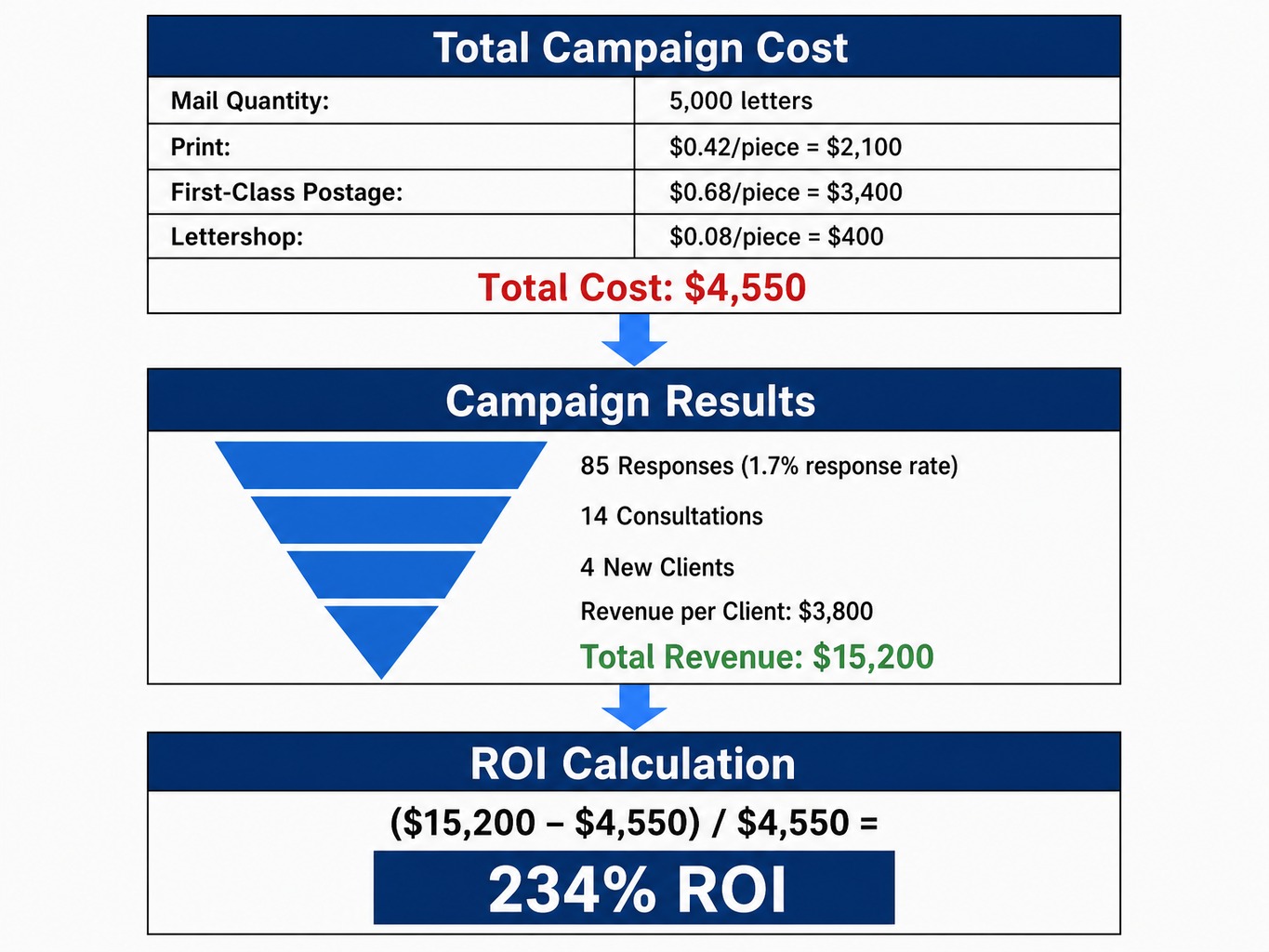
Here is a worked example: a financial advisory firm mails 5,000 letters to business owners filtered by SIC code, geography, and annual sales volume above $1M.
- Total Cost: $4,550
- List Access & Export: Part of an ongoing subscription.
- Print: $0.42/piece = $2,100
- First-Class Postage: $0.68/piece = $3,400 (Note: As of early 2026, rates are subject to change by USPS.)
- Lettershop (folding, inserting, sealing): $0.08/piece = $400
- Responses: The mailing generates 85 inbound calls and form fills (a 1.7% response rate).
- Conversions: Of those 85 responses, 14 convert to consultations, and 4 become clients with an average first-year revenue of $3,800 each.
- Campaign Revenue: 4 clients * $3,800/client = $15,200
Now, calculate the ROI:
($15,200 – $4,550) / $4,550 * 100 = 234% ROI
While the Association of National Advertisers (ANA) reports a median direct mail ROI of 15-17%, that figure includes broad, untargeted campaigns. As the example shows, a precisely targeted list can produce returns that are multiples of that benchmark. The critical insight is that every variable in this formula is influenced by list targeting before the piece is even designed.
Read more: Financial Advisor Lists – Email, Phone and Mailing Lists from Infofree
Why List Quality Is the Largest ROI Variable
When a direct-mail campaign underperforms, the instinct is to redesign the creative or switch formats, but the math usually points elsewhere. A list built on loose criteria inflates the cost denominator of the ROI formula with records that had no realistic chance of converting. Platforms like InfoFree, which expose granular filters for homeowner status, income band, and move date, let the mailer remove those dead-weight records before the print file is finalized.
In the ROI formula, list quality influences response rate, conversion rate, and revenue per customer simultaneously. A mailing sent to a well-matched audience simply performs better. According to the Data & Marketing Association, house lists (your own customers) can generate response rates of 5-9%, while prospect lists average 2-5%. The gap is explained by relevance.
Targeted Lists Compress Cost per Acquisition
Consider an insurance agency marketing Medicare Supplement plans. Mailing to a broad list of adults aged 60+ in a metro area might produce a 1.2% response rate. But filtering that list changes the economics.
A regional insurance agency runs two direct-mail campaigns in the same quarter to the same geography. Campaign A uses a broad consumer list filtered only by ZIP code and age. Campaign B uses the same ZIP codes but adds homeowner status, estimated income band, and length of residence as filters. Campaign B’s list is 40% smaller. Both campaigns use the same creative and postage. If Campaign B generates even a comparable number of responses on a smaller mail volume, its ROI is structurally higher because the cost denominator shrank while the revenue numerator held.
The list did the work that no headline or envelope teaser could do. Narrowing a list is not reducing opportunity it is concentrating spend on the records where the offer is most relevant.
Broad Lists Hide Waste in Postage and Print
Every piece mailed to a household that has no plausible need for your offer is a sunk cost, typically between $0.50 and $0.90 depending on format and postage. On a 10,000-piece mailing, if 30% of recipients are fundamentally mismatched renters for a homeowner service, for instance that is $1,500 to $2,700 in print and postage that cannot produce a return.
This waste is hidden inside the cost denominator of the ROI calculation. A filtered list where the same budget reaches fewer but better-matched households has a higher probability of success from the start. Before your next campaign, ask yourself: how much of my last mailing went to people who were never going to respond, no matter how good the creative was? Using homeowner lead lists to filter out renters is one of the simplest ways to eliminate this waste.
How to Track Direct Mail Conversions Without Enterprise Tools
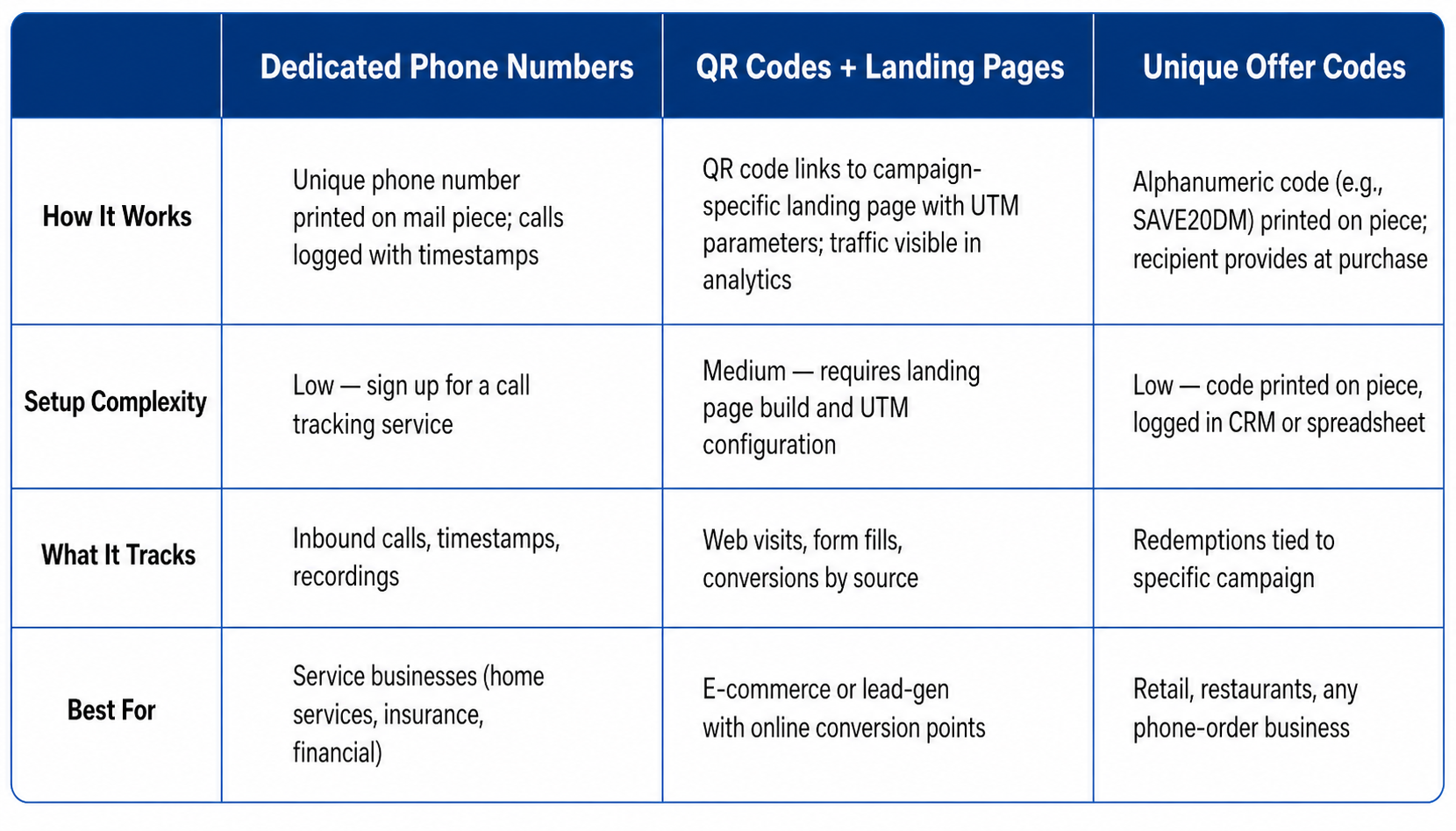
Direct mail ROI cannot be calculated if responses are not tracked back to the mailing. Digital channels have built-in attribution; direct mail requires a deliberate setup. Here are three methods that work for small teams and owner-led businesses.
- Dedicated Phone Numbers: Use a unique, campaign-specific phone number from a service like CallRail. For a few dollars a month per number, you can log every inbound call, see timestamps, and listen to recordings. A home-services contractor using a dedicated number on a postcard campaign to new homeowners might track 34 inbound calls over three weeks, attribute nine booked jobs to the mailing, and calculate actual ROI rather than guessing.
- QR Codes and Landing Pages: Print a QR code on the mail piece that links to a campaign-specific landing page. The URL for that landing page should include UTM parameters (e.g.,
yourdomain.com/?utm_source=direct_mail). This allows you to see the traffic and any resulting conversions as a distinct source inside Google Analytics. - Unique Offer Codes: This is the simplest method. Print a unique alphanumeric code on the mail piece (e.g.,
SAVE20DM) that the recipient provides when calling or ordering. Your sales team can then log this code in your CRM or a simple spreadsheet to attribute the sale.
The tracking method must be decided before the piece is designed, as it affects the layout. It’s also important to remember that any follow-up calling or emailing to respondents remains your responsibility to conduct in compliance with DNC, TCPA, CAN-SPAM, and applicable state privacy laws.
How Stale Data Erodes Direct Mail ROI
Every piece of mail sent to an address where the recipient no longer lives is a complete loss of print, postage, and fulfillment costs. This undeliverable mail, known in the industry as a “nixie,” contributes nothing to revenue but inflates the cost denominator of your ROI formula.
On a mailing list that has not been updated in 12 months, nixie rates can run as high as 8–12%, depending on the audience segment. For a 5,000-piece mailing at a loaded cost of $0.85 per piece, a 10% nixie rate is $425 in pure waste before a single response is counted.
Two standard data processing steps are designed to prevent this.
- NCOA (National Change of Address): This process cross-references a mailing list against the 48-month USPS change-of-address database, flagging or updating records for individuals and families who have moved.
- CASS (Coding Accuracy Support System): This USPS certification process standardizes addresses to match postal service records, correcting ZIP codes, street names, and abbreviations to improve deliverability.
As a rule, you should run NCOA and CASS processing on any list that is more than 90 days old. For campaigns targeting new movers, the data decays even faster. A new-mover record loses its primary outreach value within 30 days, as the household quickly locks in its local service providers. Data freshness is not an abstract quality concern it is a line item in your ROI calculation.
Format and Postage Decisions That Protect Margin
The format and postage class you choose affect both your cost per piece and your response rate. The right choice depends on your campaign’s economics and goals.
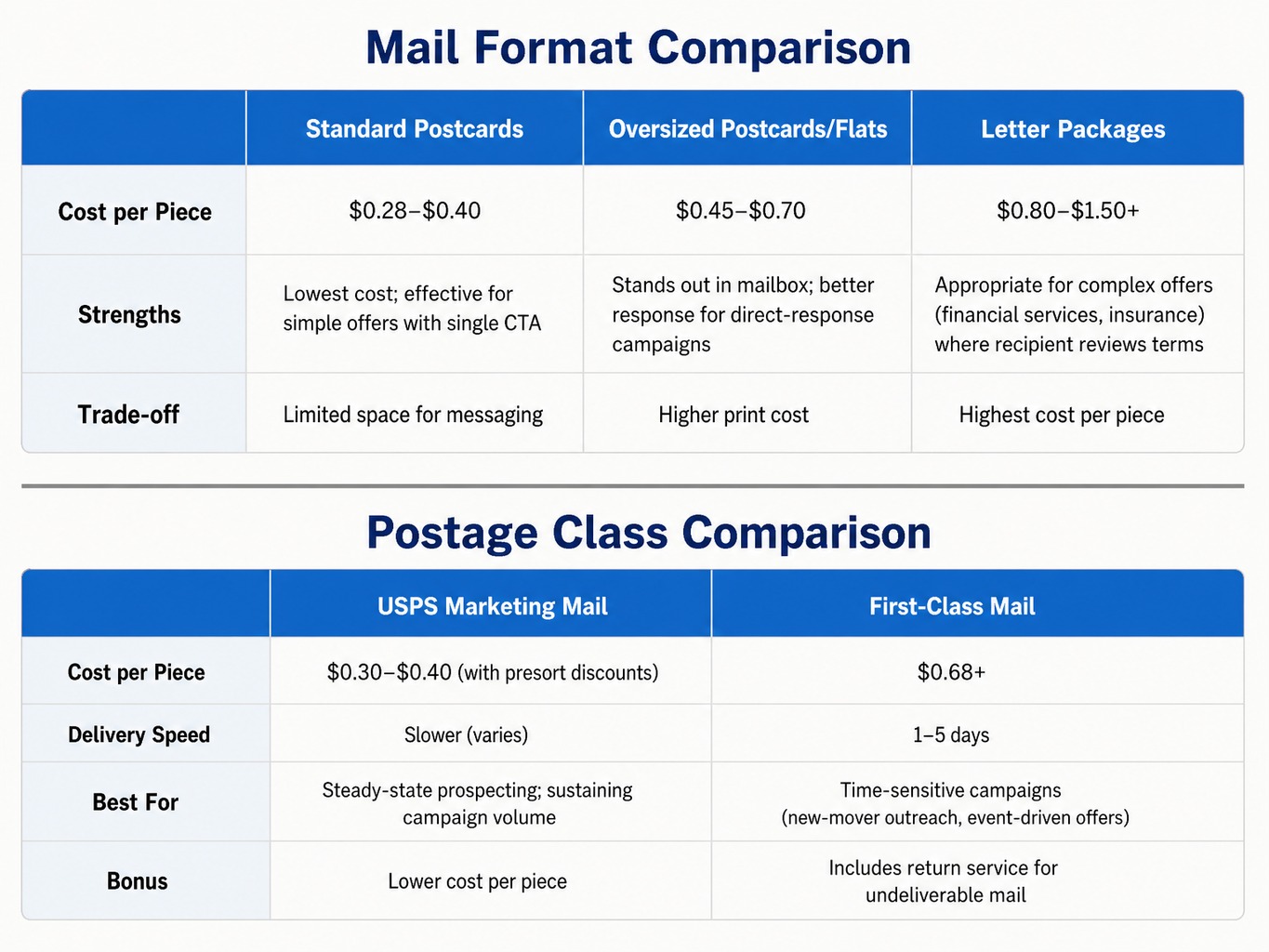
Here is a concise comparison of common formats:
- Standard Postcards: Lowest cost per piece, typically $0.28–$0.40 printed. They are effective for simple offers with a single, clear call to action.
- Oversized Postcards/Flats: Higher print cost at $0.45–$0.70. Their size helps them stand out in the mailbox, often leading to better response rates for direct-response campaigns.
- Letter Packages: Highest cost at $0.80–$1.50+ per piece. Including a letter, brochure, and a business reply envelope (BRE) is appropriate for complex offers like financial services or insurance where the recipient needs to review terms before responding.
Postage is the other half of the equation:
- USPS Marketing Mail: This class (formerly Standard Mail) offers lower rates for volume mailings, often running $0.30–$0.40 per piece with presort discounts. It is the default for steady-state prospecting.
- First-Class Mail: At $0.68+ per piece, this is more expensive but delivers faster (1-5 days) and includes return service for undeliverable mail.
For campaigns where response timing is critical such as new-mover outreach or event-driven offers First-Class postage is often worth the premium. For general prospecting, USPS Marketing Mail helps keep the cost per piece low enough to sustain campaign volume.
How InfoFree Supports Targeted List Building for Direct Mail Campaigns
The central argument of this article is that direct mail ROI is determined by list targeting precision, data freshness, and attribution. The platform where you build your list is where you control these variables.
InfoFree provides a single platform to build both B2C and B2B marketing lists using the specific filters that improve campaign economics.
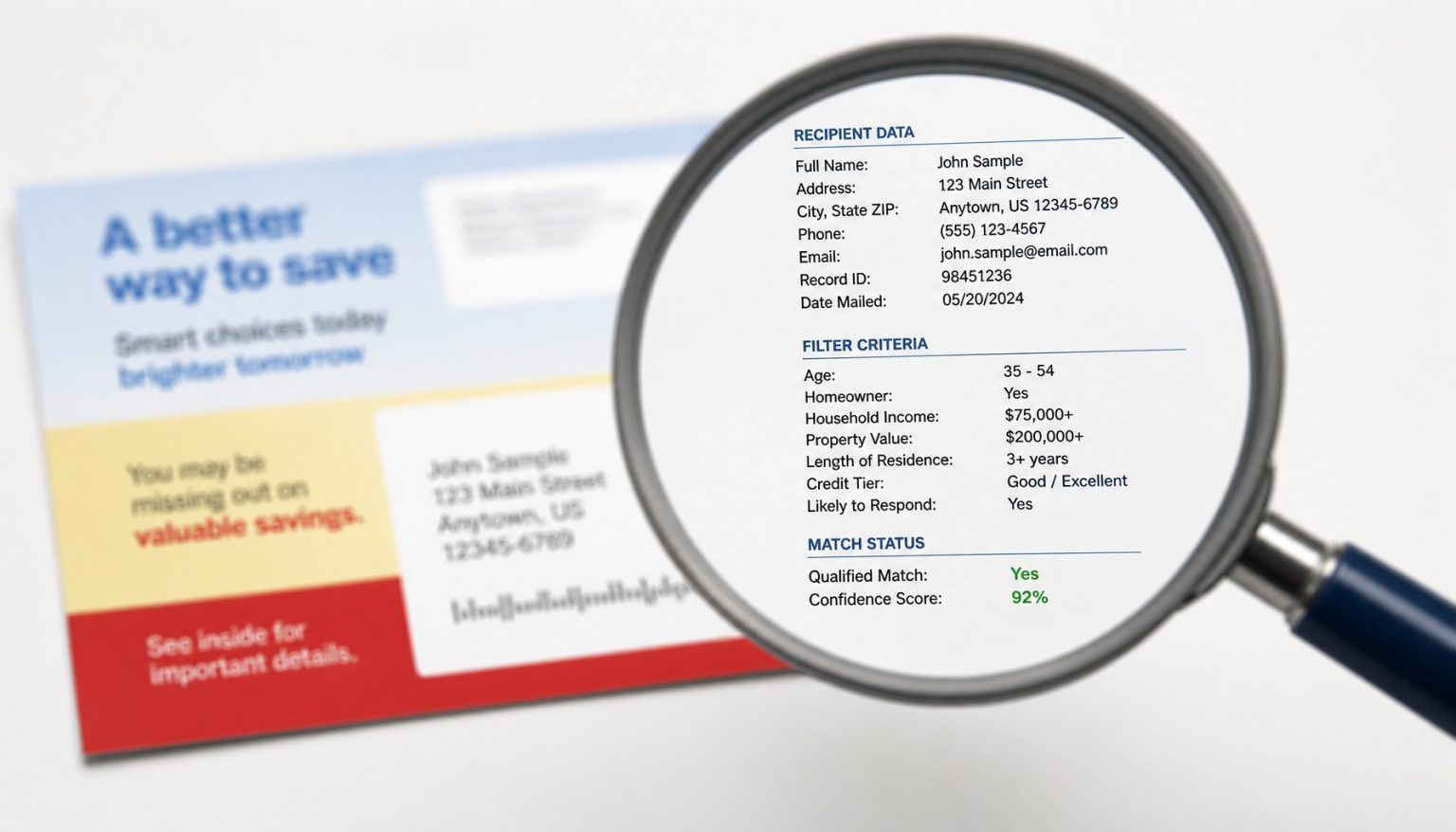
- For B2C campaigns, you can filter the consumer database by homeowner status, estimated home value, household income, age, geography, and new mover status to concentrate your mail spend on relevant households.
- For B2B campaigns, you can search the business database by SIC and NAICS code, employee count, annual sales volume, and geography, then target a specific executive by title to ensure your mail reaches a decision-maker.
The workflow works in four steps: search the databases, apply filters to define your segment, build a list, and export. Export limits vary by plan. CRM101, the included sales notation tool, manages follow-up directly from the same platform. InfoFree’s business records are triple-verified and rated at 95% accuracy (a company claim). Consumer and household records are compiled from a separate set of sources and are not rated on the same standard.
The platform offers unlimited search and view access across both database families, with export limits that vary by plan. Any calling, emailing, or mailing to exported records remains the customer’s responsibility to conduct in compliance with DNC, TCPA, CAN-SPAM, and applicable state privacy laws.
Your List Defines Your ROI
Direct mail ROI is not a function of how much you spend on design or how many pieces you mail. It is a function of how precisely your list matches your offer to the recipient’s situation, how fresh the data is when you mail, and whether you have attribution in place to measure the result.
The formula is simple; the discipline is in the list. Before you launch your next campaign, run the ROI calculation on your last one. If the numbers are not there, the first place to look is not the creative it is the list criteria.
Frequently Asked Questions
What is a realistic direct mail response rate for a targeted list in 2026?
Response rates vary by list type, offer, and industry. As a general benchmark from the Data & Marketing Association, house lists (existing customers) often see 5-9% response rates, while prospect lists run 2-5%. These are directional ranges, not guarantees. Response rate alone does not determine ROI; conversion rate and customer value are equally important.
How does direct mail ROI compare to email marketing ROI?
The comparison depends on what costs are included. Email has a lower cost per send but typically a much lower response rate on cold lists. Direct mail has a higher cost per piece but can achieve higher response and conversion rates with well-targeted lists. The more useful comparison is cost per acquisition, as the cost structures are fundamentally different. All email outreach must comply with CAN-SPAM and applicable state privacy laws.
What is the difference between targeted direct mail and saturation marketing?
Targeted direct mail is sent to a list filtered by specific criteria (demographics, homeowner status, industry, etc.) to ensure relevance. Saturation marketing mails to every deliverable address within a postal carrier route, typically through the USPS Every Door Direct Mail (EDDM) program. Targeted campaigns tend to have higher response rates and lower cost per acquisition, while saturation campaigns offer broader reach at a lower cost per piece but with more waste. InfoFree builds targeted, filtered lists rather than EDDM saturation lists.
Does direct mail work for B2B prospecting, or is it primarily a B2C channel?
Direct mail is effective for both, but the strategy differs. B2B campaigns mail to smaller, highly filtered lists, targeting companies by SIC or NAICS code, size, and geography, and addressing a specific executive by title. B2C campaigns use larger lists filtered by demographic, household, and property attributes. The ROI formula is the same for both; only the variables change.
How can mover and homeowner data improve direct mail ROI?
New movers and homeowners are actively seeking local services insurance, dental, HVAC, landscaping in the first few weeks after moving. Mailing to this audience during that window meets an active need, resulting in higher response rates. Filter by move date within the last 30 days and homeowner status to concentrate spend on households ready to buy.